
Outdoor wedding ceremony sound in Alaska: a mic for vows
5 min read ZION Entertainment
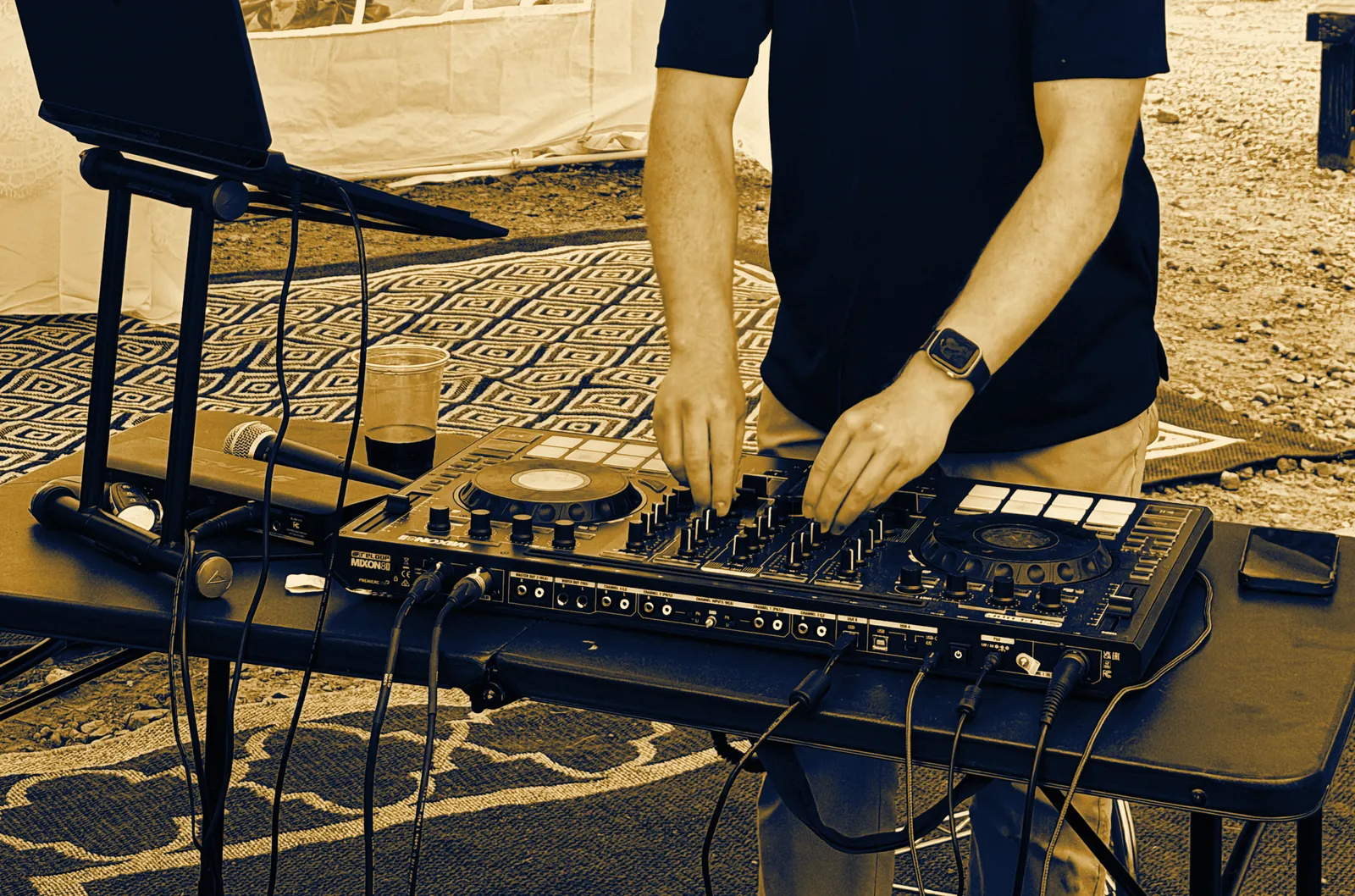
If your ceremony is outside, put a microphone close to whoever is speaking and a powered speaker at the front, aimed at your guests. Open air gives a speaking voice nothing to bounce off, so without a mic the back half of the crowd hears wind and maybe a word or two. Then test the whole setup before anyone sits down.
Why can’t guests hear the vows at an outdoor ceremony?
Indoors, the room helps you. Walls and a ceiling throw your voice back at the guests, so even a quiet “I do” carries a little.
Outside, nothing throws it back. In open air, doubling the distance drops the level by about 6 decibels. So a guest 40 feet back hears your unamplified voice about 12 decibels quieter than someone 10 feet away.
And the people talking aren’t helping. You’re facing each other, and nerves make most people quiet. The officiant might project fine. The two voices that matter most usually don’t.
Then there’s wind, which turns into a low rumble on a microphone. Shure’s advice for its outdoor interview mic is to keep the foam windscreen on and use a bigger one in extreme wind, and it credits that mic’s omnidirectional design with cutting wind noise.
Handheld or lavalier: which mic works better for vows?
A handheld is the simple option. The officiant holds it and tips it toward each of you for the vows, so a person controls how close it sits to each mouth. That matters, because keeping the mic close is the biggest single thing you can do to get volume without feedback. The cost is a hand. Shure notes that a handheld limits natural gestures, which you’ll feel during the ring exchange.
A lavalier clips to clothing and mostly disappears in photos. But it hears the person wearing it best, and the same Shure article notes that as the wearer moves, the distance to the mouth changes, and the level changes with it. Clip it on the officiant and it may barely catch you two.
For most outdoor ceremonies, the handheld is the safer bet. It’s less elegant, and there’s less to go wrong.
Where should the ceremony speaker go?
Put it at the front, off to one side of the arch or altar, a little ahead of where the officiant stands and facing the guests. That way the voice seems to come from roughly where you’re standing, and the mic stays behind the speaker, where it’s less likely to squeal.
Get it up off the ground if you can, so the sound travels over the first rows of heads. If it goes on a tripod stand, JBL’s manual for the PartyBox 310, the speaker ZION uses for ceremonies, says to use a flat, solid surface, add sandbags in windy outdoor conditions, and skip banners, which can act like a sail. A 38.4-pound speaker tipping over on soft lawn is a bad way to start a marriage.
Also, leave the aisle clear for the photographer. Nobody wants a speaker in the processional shot.
How do you power ceremony sound at an outdoor Alaska venue?
Find the outlet first. Plenty of outdoor spots have one on the side of a building, or none.
If you run a cord, use one marked for outdoor use, and per the Electrical Safety Foundation, plug it only into a GFCI outlet. Tape down or cover any stretch where guests walk.
Or skip the cord. JBL rates the PartyBox 310 at up to 18 hours on battery, but read the fine print: that assumes the light show is off, the volume is at level 18 and music is streaming over Bluetooth. Output also drops from 240 W RMS on AC power to 140 W RMS on battery. A 20- or 30-minute ceremony is well inside that if the speaker was charged. Charging takes under 3.5 hours, so do it the night before.
One catch from the same manual: the speaker switches to standby after 20 minutes of inactivity. If it sits silent while guests arrive, it can be asleep when the processional starts. Keep quiet prelude music running through it.
Do a sound check before guests sit down
It takes a few minutes. Better to find a problem now than during the vows.
- Have the officiant stand on the real spot and talk at the volume they’ll actually use.
- Walk to the back row and the far ends. If you’re straining to hear, turn it up or move the speaker.
- Check the wind. If it’s gusting, keep the windscreen on and hold the mic a bit closer.
- Decide who holds the mic for the vows and the rings, and practice the handoff once.
What about rain and cold at an Alaska wedding?
If your date is late summer, plan for rain. August and September are Anchorage’s wettest months, averaging about 2.9 and 3.1 inches of precipitation in NOAA’s 1991 to 2020 climate normals.
Gear doesn’t like water. Shure says even its rugged outdoor mic should be sheltered from rain. The PartyBox 310 is rated IPX4 splash resistant, and JBL still says to keep the charging port dry before connecting AC power. A pop-up canopy over the speaker and table is cheap insurance, and every plug belongs off the wet grass.
Cold changes things too. September lows in Anchorage average about 43°F. If the officiant throws on a jacket at the last minute, a clip-on mic needs to move to the outside of it. Shure specifically advises against placing a lavalier under layers of clothing.
Ceremony audio with ZION Entertainment
ZION’s 6-Hour Wedding Package is $750, and ceremony audio is included in that price. DJ Zion connects a microphone to a JBL PartyBox 310 for the ceremony, and the mic and speaker setup is confirmed with you in advance. You can meet with him beforehand over Zoom or in person. Extra time is $85 an hour, depending on availability and agreed in advance. Local travel within Anchorage and Eagle River is included; anywhere further is quoted individually. More on the weddings page.
If you have a date and a ceremony spot picked out, send both through the availability form and mention that the ceremony is outdoors. You can also call or text (907) 406-7211.
Sources
- HyperPhysics, Georgia State University: inverse square law for sound
- ProSoundWeb: Primer, acoustic characteristics of live sound reinforcement
- Shure: The SM63, a go-to mic for outdoor applications
- Shure: How to choose the best mic for the pastor
- JBL PartyBox 310 owner's manual
- U.S. Consumer Product Safety Commission: Household extension cords can cause fires
- Electrical Safety Foundation International: Use extension cords safely
- NOAA NCEI: 1991-2020 monthly climate normals, Anchorage International Airport