
Wedding do not play list: how to write one your DJ can use
4 min read ZION Entertainment
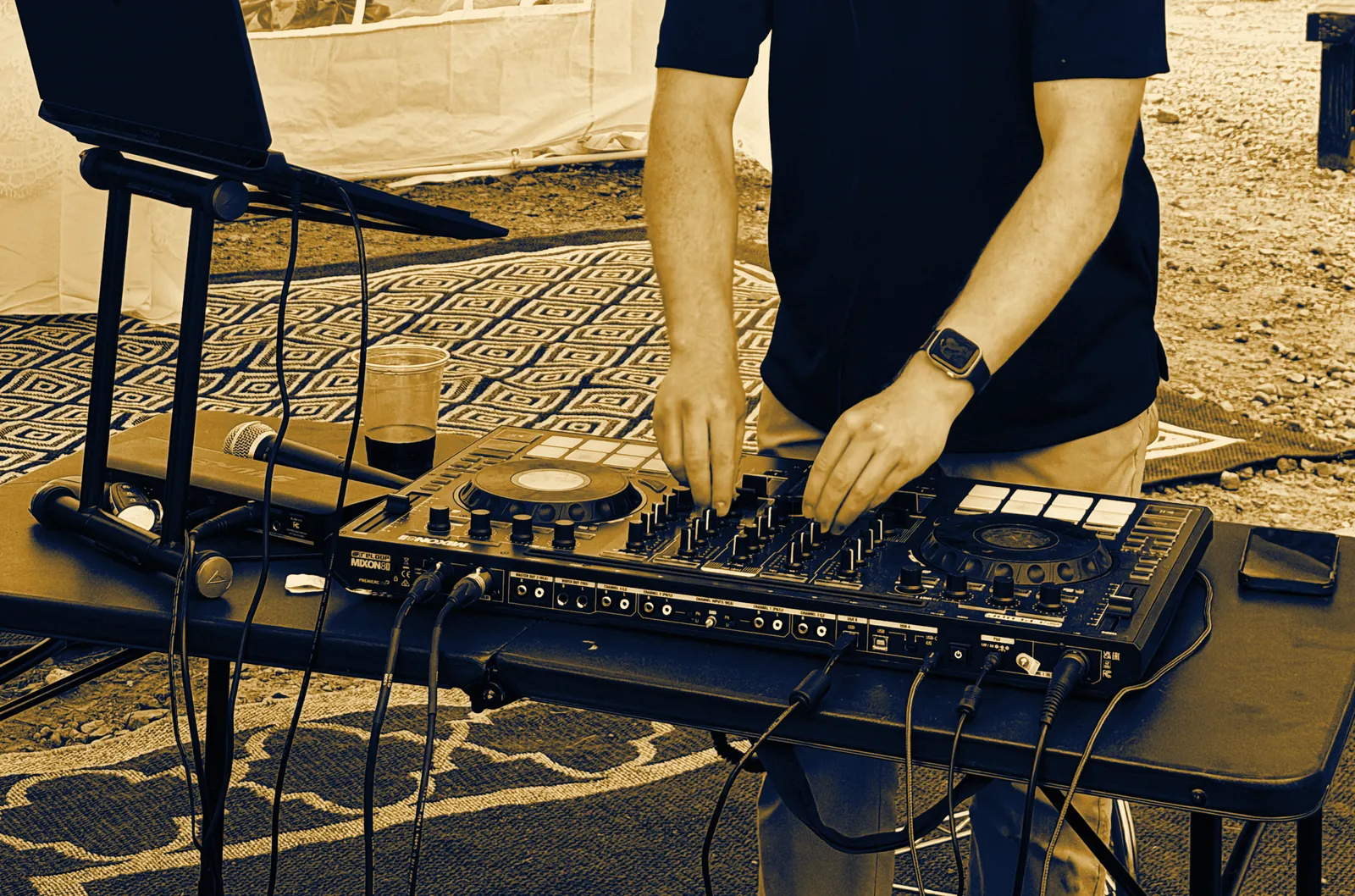
A wedding do not play list is a short list of songs, artists, or whole genres your DJ won’t play at your reception, even if someone asks. The lists that work are specific: a song title and artist, or a plainly named category, plus a one-line reason when the reason matters. Keep it short enough that your DJ can hold the whole thing in their head while running the night.
What goes on a do not play list?
Some songs land on the list because you’ve heard them at every wedding you’ve been to since college. That’s a perfectly good reason. Others land there because of who they remind you of, and those are the ones your DJ most needs to know about.
Then there are whole categories, like no country or no line dances.
One more that couples forget is explicit lyrics. You can love a song and still not want the uncut version playing while your grandmother finishes her salmon. Write “clean edits only” and your DJ will stick to radio versions without you having to ban anything.
How specific should a do not play list be?
Very. Your DJ can’t do much with “nothing cheesy,” because cheesy to you might be the exact song your college roommate has been waiting all night to hear.
Write the title and the artist. That matters more than it sounds, since plenty of songs exist in more than one version. Put “Hallelujah” on the list and your DJ has to guess whether you meant Leonard Cohen’s original or Jeff Buckley’s cover. If you only hate one of them, say which.
Categories work too, as long as you mark the edges. “No country” seems clear until someone asks for “Friends in Low Places.” Does Garth count? Decide now. Someone will ask.
Should you explain why a song is on the list?
Only when it helps your DJ make a call on the night.
“We’re tired of it” doesn’t need explaining. A song that played at a family funeral, or one that belonged to a parent’s ex, does, at least in a line. You don’t have to tell the story. “Family reason, hold firm” is enough.
That line changes how a request gets handled. A song you’re bored of is a soft no, and if the dance floor is begging for it at 10 p.m., maybe you’d let it slide. A song that’ll make your mom leave the room is a hard no for everyone, including the best man with his phone out. It helps to split your list into two parts, “never” and “rather not,” so your DJ knows which is which without asking you in the middle of your own reception.
What should the DJ do when a guest requests a banned song?
Say no nicely and play something close. If someone asks for the “Cha-Cha Slide” and you’ve banned line dances, there’s almost always a high-energy song that pulls the same people onto the floor.
Settle two things ahead of time. First, can your DJ say “the couple asked me to skip that one”? It’s the quickest way out of the conversation, but some couples would rather the DJ quietly take the blame.
Second, does anyone get an override? If your dad is going to ask for “Sweet Caroline” and you’d honestly let him have it, tell your DJ now. Otherwise your DJ ends up turning down the father of the bride in front of his friends, which is a bad look for everybody.
And don’t hand the list to guests. Give it to your DJ in writing and let the DJ be the one who says no.
How is a do not play list different from a must-play list?
A must-play list is a set of promises: these songs get played at some point. A do not play list is a filter that runs all night. Keep them on separate pages.
The must-play list is the one that gets out of hand. If yours could fill the whole reception by itself, it’s turned into a playlist, and your DJ has lost the room to respond to who’s actually dancing. Pick the songs you’d be upset to miss and trust the DJ with the rest.
You’ll probably need a third list too, for the special songs: processional, grand entrance, first dance, parent dances, cake cutting, last song. Those get exact versions and exact cue points. If you want the first dance faded out after the second chorus, write that here.
With ZION’s 6-Hour Wedding Package, music requests, special-song planning and the do-not-play list are all included, and the pre-wedding consultation with DJ Zion (Zoom or in person) is where you go through them together.
Which songs do couples ban most often?
The numbers most people quote come from a 2017 FiveThirtyEight survey of more than two dozen wedding DJs covering almost 200 weddings, as reported by Refinery29. “The Chicken Dance” was banned at 23.1% of those weddings, the “Cha-Cha Slide” at 22.5%, and the “Macarena” at 17.6%. The average couple made 5.5 do-not-play requests. One couple made 66.
The full list of 48 songs reads about how you’d expect. “Cupid Shuffle” by Cupid, “YMCA” by Village People, “Electric Boogie (Electric Slide)” by Marcia Griffiths, “Cotton Eye Joe” by Rednex. Lots of line dances and group-participation songs. “Shout” by the Isley Brothers made it, and so did Pharrell’s “Happy.”
It’s an old survey with a small sample, so read it as a guide to the usual suspects and nothing more precise than that.
Also, every ban is a trade. The “Cha-Cha Slide” gets requested for the same reason it gets banned: everybody knows the steps. Cut it and you’re betting your crowd will dance without being told how. That’s a fair bet. Just make it on purpose.
If you’re planning a wedding in Anchorage or Eagle River, start a rough list now, even five songs, and bring it to your consultation. See what the wedding package covers, then check your date on the availability page or call or text (907) 406-7211. Nothing is booked until DJ Zion confirms the date.